

The 60-Day Grace Period After a Job Ends, and the DHS Proposal to Remove It

Say your H-1B employer tells you on a Thursday that Friday is your last paid day. From Saturday, a clock may be running: up to 60 days in which you are not out of status just because the job ended, and in which you may not work.
As of 25 November 2026, that 60-day grace period is still the rule. It lasts up to 60 consecutive days, or less if your authorized validity period ends sooner, and USCIS can shorten it. On 11 September 2026, DHS proposed removing it. The comment period closed on 10 November 2026, and no final rule has been published.
The worker in that example is hypothetical, not a client. Their spouse is in H-4 status and holds a work permit (an Employment Authorization Document, or EAD). The same rule covers E-1, E-2, E-3, H-1B1, L-1, O-1 and TN workers, and where their options differ, the sections below say so.
What is the 60-day grace period?
The 60-day grace period is a federal regulation, 8 CFR 214.1(l)(2), that stops certain temporary workers and their families from being treated as out of status only because a job ended. It covers E-1, E-2, E-3, H-1B, H-1B1, L-1, O-1 and TN workers and their dependents, and it has applied since 17 January 2017.
The regulation says, in full:
"An alien admitted or otherwise provided status in E-1, E-2, E-3, H-1B, H-1B1, L-1, O-1 or TN classification and his or her dependents shall not be considered to have failed to maintain nonimmigrant status solely on the basis of a cessation of the employment on which the alien's classification was based, for up to 60 consecutive days or until the end of the authorized validity period, whichever is shorter, once during each authorized validity period. DHS may eliminate or shorten this 60-day period as a matter of discretion. Unless otherwise authorized under 8 CFR 274a.12, the alien may not work during such a period."
"Up to" and "whichever is shorter" mean the period can be less than 60 days: if your approved validity period ends three weeks after your last day, three weeks is what you have. "Once during each authorized validity period" means one grace period per approval, and "as a matter of discretion" means USCIS decides. The last sentence rules out work unless something else authorizes it.
Before the rule took effect, DHS says a worker whose job ended was generally treated as out of status from the next day. That history matters later, because the September 2026 proposal would bring it back.
The 60 days are separate from the 10-day windows in 8 CFR 214.1(l)(1) (for O-1, 8 CFR 214.2(o)(10)), which allow a stay of up to 10 days before a validity period starts and 10 days after it ends. DHS explains that those 10 days don't help someone whose job ends partway through the validity period.
When does the grace period start, and when does it end?
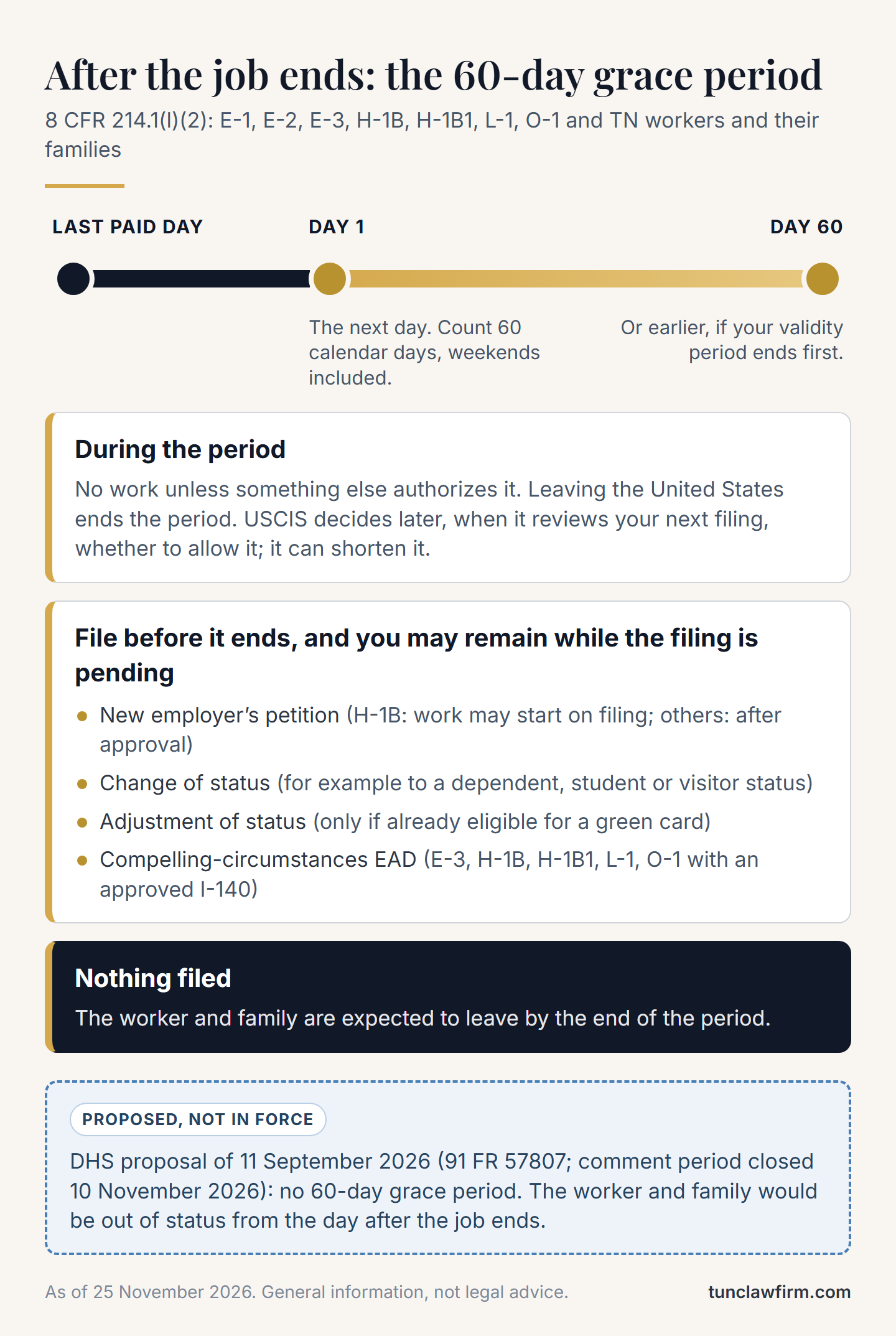
The grace period starts the day after your employment ends, which USCIS has described as typically the last day for which you are paid. It runs for up to 60 consecutive calendar days, weekends included. It ends sooner if your authorized validity period ends first, and it ends when you leave the United States.
USCIS set out these points on its page "Options for Nonimmigrant Workers Following Termination of Employment." That page now sits in USCIS's online archive, labelled as out of date, but DHS still cited it in its September 2026 proposal.
In the example, Friday is the last paid day, so Saturday is day 1. It would make no difference if the worker had resigned: USCIS says the grace period can apply whether employment ends voluntarily or involuntarily, and DHS repeated this in its proposal.
USCIS also says the grace period ends on any departure from the United States. If your job ends while you are abroad, with no notice period you can return within, it generally does not apply. A later approval with a new validity period, such as a new employer's petition, can bring a new grace period if that job also ends.
Is the grace period automatic?
No. There is no application for the grace period itself. USCIS decides whether you had one, and for how long, when it reviews the next petition or application filed for you, such as a new employer's petition or a change of status. Until then, nobody confirms it, and USCIS may shorten or eliminate it.
USCIS has suggested that the filer ask for it in the cover letter, requesting that USCIS favorably exercise its discretion to grant the period. The filer also has to show the date the old job ended. DHS notes in its proposal that payroll records often don't state the last day of work, which leaves officers to infer it, so a termination letter that gives the last day and the final pay statement are worth keeping.
DHS lists circumstances that can lead USCIS to shorten or deny the period: status violations, unauthorized work during the grace period, fraud or national security concerns, and criminal convictions, among others.
Can you work during the grace period?
Not on the basis of the job that ended. The regulation bars work during the grace period unless something else authorizes it. Two exceptions come up often: an eligible H-1B worker may start with a new H-1B employer as soon as that employer properly files its petition, and a spouse's own work authorization stays valid.
The H-1B rule is called portability (8 CFR 214.2(h)(2)(i)(H)). It applies when the new employer files a nonfrivolous H-1B petition before your authorized stay expires, and you haven't worked without authorization since your last admission. You may start on the filing date or the requested start date, whichever is later.
E-1, E-2, E-3, H-1B1, L-1, O-1 and TN workers have no equivalent: they must wait until USCIS approves the new petition. With premium processing, USCIS must act on most of these petitions within 15 business days (8 CFR 106.4). Acting can mean an approval, a denial or a request for more evidence, and a request for evidence restarts the count.
Which filing to make is the next decision.
What can you file before the 60 days run out?
USCIS lists four filings that can keep you in an authorized period of stay past the end of the grace period: a new employer's petition, a change of status, an adjustment of status if you qualify, and a compelling-circumstances EAD. The other choice is to leave. A filing generally has to be made before the grace period ends.
Option | Who it fits | What it does for your stay | When you can work |
|---|---|---|---|
New employer's petition (Form I-129) | Any covered worker with a new job offer | You may remain while a timely, nonfrivolous petition is pending | H-1B: on filing. Others: after approval |
Change of status (Form I-539, or with a new employer's I-129) | For example, to H-4, L-2 or E dependent, F-1 student, or B-1/B-2 visitor | You may remain while a timely, nonfrivolous application is pending | Depends on the new status; visitors may not work |
Adjustment of status (Form I-485) | Only workers already eligible to apply for a green card | You may remain while it is pending, and can apply for an EAD | Once the EAD is issued |
Compelling-circumstances EAD (Form I-765) | E-3, H-1B, H-1B1, L-1 and O-1 workers with an approved Form I-140 | You may remain while the EAD is valid, but you are no longer in nonimmigrant status | Once the EAD is issued |
Leaving the United States | Anyone | The grace period ends on departure | After returning in a new status |
What if a new employer wants to hire you?
The new employer files Form I-129 for you, usually with a request to extend your stay or change your status. If the petition is filed within the grace period and is nonfrivolous, USCIS says you may remain in the United States while it is pending.
If your old employer takes you back in the same position while its petition is still valid, USCIS says you can resume work with no further filing. If that employer has already told USCIS you left, the approval was revoked and a new petition is needed.
Can you change to another status while you look?
Yes, if you are still in status when you file. A change of status generally can't be approved if you stopped maintaining status, or your stay expired, before you filed; USCIS can excuse a late filing only in extraordinary circumstances beyond your control (8 CFR 248.1(b)). Common choices are a spouse's dependent status (H-4, L-2 or E), F-1 student status, or B-1/B-2 visitor status. USCIS says visitors may look for work and attend interviews but may not work.
A timely, nonfrivolous change of status also stops unlawful presence from building up while it is pending, as long as you haven't worked without authorization. If it is denied, USCIS says unlawful presence starts the day after the denial.
When is adjustment of status an option?
Only if you can already apply for a green card from inside the United States. USCIS gives self-petitioning categories such as EB-1 extraordinary ability, where the immigrant petition and the green card application can be filed together, as examples. With an application pending, you are generally in an authorized period of stay and can apply for an EAD. The firm's extraordinary ability page covers EB-1A.
What is a compelling-circumstances EAD?
It is a one-year work permit that USCIS may grant, at its discretion, to an E-3, H-1B, H-1B1, L-1 or O-1 worker who has an approved employment-based immigrant petition (Form I-140), whose priority date is not yet current, and who shows compelling circumstances. The worker must be in status, including the grace period, on the day the application is filed.
USCIS gives examples of what counts as compelling: serious illness or disability, employer retaliation, other substantial harm to you or your family, or significant disruption to the employer. A conviction for a felony or for two or more misdemeanors makes a worker ineligible (8 CFR 204.5(p)(5)). Spouses and children can apply in their own category once the worker's EAD is approved.
USCIS says that once you work on this EAD, you are in a period of authorized stay but no longer in nonimmigrant status. You can't then change or extend status inside the United States, and when your priority date becomes current, you would generally finish the green card process at a U.S. consulate abroad.
E-1, E-2 and TN workers are not eligible for this EAD.
What if you decide to leave?
Leaving is always an option, and it ends the grace period. If an H-1B employer dismisses you before the end of your authorized stay, it must pay the reasonable cost of your return transportation; that doesn't apply if you resigned (8 CFR 214.2(h)(4)(iii)(E)). For O-1 workers whose employment ends other than by resignation, the employer and the petitioner share that cost (8 CFR 214.2(o)(16)). From abroad, you can apply to return once a new petition or visa is approved.
What happens if nothing is filed by day 60?
If the grace period ends with no petition or application filed, the worker and the family are expected to leave the United States. Staying on means failing to maintain status. DHS notes that a person who fails to maintain status is deportable under INA 237(a)(1)(C)(i), and that it can count against later applications, including adjustment of status.
What happens to your spouse and children?
Dependents share the grace period. Your spouse and unmarried children under 21 are not treated as out of status for the period your own grace period covers, and USCIS says a spouse's EAD, or work authorization that comes with their status, stays valid during it. Their status still depends on yours, so the deadline that applies to you applies to them.
In the example, the H-4 spouse can keep working on the EAD during the 60 days. Spouses of E-1, E-2, E-3 and L-1 workers are in the same position with the work authorization that comes with their status. If the worker obtains a compelling-circumstances EAD, the spouse and children can apply for their own, provided they were in status when the worker applied.
What about E-2 employees?
The grace period covers E-1 and E-2 workers and their families, but an E-2 employee's next job has extra conditions. Under 8 CFR 214.2(e)(3), the new employer must share your nationality: it must be a national of your country who holds treaty investor or treaty trader status in the United States (or would qualify for it, if outside the United States), or an enterprise at least 50 percent owned by such nationals. The new job must be executive or supervisory, or you must have special qualifications that make your services essential to the enterprise's efficient operation. A move to a different employer is also a substantive change under 8 CFR 214.2(e)(8)(iii), so it needs a new USCIS approval before you start, or a new E visa obtained abroad. There is no portability for E-2.
What should employers know when a sponsored worker leaves?
For H-1B workers, the employer must tell USCIS when the worker no longer works there, and that notice revokes the petition approval automatically. DHS notes that E-1, E-2, E-3, H-1B1, L-1 and TN employers have no such notification duty. An employer that dismisses an H-1B worker early owes the reasonable cost of return transportation, and O-1 employers and petitioners share that cost. An employer hiring someone who is in a grace period should expect USCIS to ask when the old job ended.
Is the 60-day grace period being eliminated?
Not as of 25 November 2026. On 11 September 2026, DHS published a proposal to remove it (91 FR 57807). A proposal does not change the law: the grace period stays in force unless DHS publishes a final rule and that rule takes effect. The comment period closed on 10 November 2026 without an extension, and no final rule has been published.
The proposal, "Eliminating the Discretionary 60-Day Grace Period" (docket USCIS-2026-0364, RIN 1615-AD22), would:
- delete 8 CFR 214.1(l)(2), the 60-day rule, for all eight classifications at once;
- treat workers and their dependents as failing to maintain status from the day after the worker's employment ends, so they would have to leave immediately unless something else allows them to stay;
- remove the reference to the 60-day period from the compelling-circumstances EAD rule (8 CFR 204.5(p)(1)(i)), which today lets workers file during the grace period.
It would keep the 10-day windows in 8 CFR 214.1(l)(1) and the rule that a person in an authorized period may apply to extend or change status. DHS also says workers could still leave, find a new job and apply to come back once a new petition is approved.
DHS gives two reasons: that the grace period doesn't fit the statutes, which tie these statuses to the job, and that reviewing it is a burden. It counted more than 1.9 million petitions and applications, from October 2017 to 20 May 2026, where USCIS potentially had to check whether the grace period applied.
The proposed text includes no transition rule for people already in a grace period, and there is no effective date because there is no final rule. As of 25 November 2026, the Federal Register lists no other document in the docket or under RIN 1615-AD22.
The comment period on docket USCIS-2026-0364 ended at midnight Eastern time at the end of 10 November 2026, and the docket does not accept late comments.
A separate DHS proposal of 14 October 2026 (91 FR 65119) would remove USCIS's deference to earlier approvals when it decides extensions. It is also only proposed; its comment period closed on 13 November 2026, and no final rule has been published.
What do the 60 days look like for the example worker?
Back to the H-1B worker whose last paid day was a Friday. Saturday is day 1. If a new H-1B employer files a nonfrivolous petition during the period, the worker can start there on filing, and the spouse's EAD stays valid throughout. If no employer files in time, the worker can apply for a change of status or leave before the period ends; doing neither means staying on without status.
If the September 2026 proposal became final as written, the same worker and spouse would be out of status from Saturday unless something else allowed them to stay. As of 25 November 2026, that is only a proposal, and the 60-day rule applies today.
If your job has ended or is about to, three dates decide which options are still open: your last paid day, the end of your validity period, and the filing date of anything already pending. You can book a consultation to go through them with an attorney.
Frequently asked questions
Does the 60-day grace period apply if I quit my job?
Yes. USCIS has said the grace period can apply whether employment ends voluntarily or involuntarily, and DHS repeated that in its September 2026 proposal. It remains discretionary: USCIS decides whether to allow it, and for how long, when it reviews the next petition or application filed for you.
Is the H-1B 60-day grace period still in effect?
Yes, as of 25 November 2026. The rule at 8 CFR 214.1(l)(2) is in force. DHS proposed removing it on 11 September 2026 (91 FR 57807), and the comment period closed on 10 November 2026, but a proposal doesn't change the law. Only a final rule published in the Federal Register, once it takes effect, could do that.
Can I work during the 60-day grace period?
Not under the status based on the job that ended. The regulation bars work during the period unless something else authorizes it. An eligible H-1B worker may start with a new H-1B employer once that employer properly files a nonfrivolous petition; E, L-1, O-1 and TN workers must wait for the new petition to be approved.
Can I travel outside the United States during the grace period?
Leaving ends it. USCIS's guidance says the grace period ends on any departure from the United States, so returning requires another status or visa that allows reentry, such as one based on a new employer's approved petition. If your job ends while you are abroad, the grace period generally doesn't apply.
Can I use the 60-day grace period more than once?
Once per authorized validity period. If you later receive a new validity period, for example through a new employer's approved petition, and that job also ends, a new grace period of up to 60 days may be available. USCIS still decides each time whether to allow it.
Does my spouse's EAD stay valid during my grace period?
Yes. USCIS's guidance says a dependent spouse's EAD (Employment Authorization Document), or work authorization that comes with their status, remains valid during the worker's grace period. Under the September 2026 proposal, dependents would instead be out of status from the day after the worker's job ends, unless something else allowed them to stay.
Related service: Employment-Based Immigration
Sources
- 8 CFR 214.1(l) (grace period and 10-day windows), (c)(4): https://www.ecfr.gov/current/title-8/part-214/section-214.1
- 8 CFR 214.2(e)(3) and (e)(8) (E employees), (h)(2)(i)(H) (H-1B portability), (h)(4)(iii)(E) and (h)(11)(ii) (H-1B employers), (o)(10) and (o)(16) (O-1): https://www.ecfr.gov/current/title-8/part-214/section-214.2
- 8 CFR 204.5(p) (compelling-circumstances EAD): https://www.ecfr.gov/current/title-8/part-204/section-204.5
- 8 CFR 274a.12(c)(35)–(36): https://www.ecfr.gov/current/title-8/part-274a/section-274a.12
- 8 CFR 248.1 (change of status): https://www.ecfr.gov/current/title-8/part-248/section-248.1
- 8 CFR 106.4 (premium processing): https://www.ecfr.gov/current/title-8/part-106/section-106.4
- INA 237(a)(1)(C)(i), 8 U.S.C. 1227(a)(1)(C)(i) (failure to maintain status): https://www.govinfo.gov/content/pkg/USCODE-2025-title8/html/USCODE-2025-title8-chap12-subchapII-partIV-sec1227.htm
- DHS, "Eliminating the Discretionary 60-Day Grace Period," proposed rule, 91 FR 57807 (11 September 2026): https://www.federalregister.gov/documents/2026/09/11/2026-18631/eliminating-the-discretionary-60-day-grace-period (PDF: https://www.govinfo.gov/content/pkg/FR-2026-09-11/pdf/2026-18631.pdf)
- Docket USCIS-2026-0364: https://www.regulations.gov/docket/USCIS-2026-0364
- USCIS, "Options for Nonimmigrant Workers Following Termination of Employment" (archived page, last reviewed 24 January 2025): https://www.uscis.gov/archive/options-for-nonimmigrant-workers-following-termination-of-employment-0
- USCIS, "Employment Authorization in Compelling Circumstances": https://www.uscis.gov/working-in-the-united-states/information-for-employers-and-employees/employment-authorization-in-compelling-circumstances
- DHS, "Removing Deference to Prior USCIS Determinations of Eligibility," proposed rule, 91 FR 65119 (14 October 2026): https://www.federalregister.gov/documents/2026/10/14/2026-20941/removing-deference-to-prior-uscis-determinations-of-eligibility
Reading this article does not create an attorney-client relationship; every case is assessed on its own facts.
Attorney Advertising. Prior results do not guarantee a similar outcome. This website is for informational purposes only and does not constitute legal advice.
Have a question about your case?
Schedule a confidential consultation with our immigration attorneys to discuss your options.
Schedule a consultation
Get Started Today
Take the First Step Toward Your Immigration Goals
Whether you're seeking a business visa, green card, or citizenship, our team is ready to help you navigate the path forward with confidence and clarity.